
Durag vs Wave Cap: Which One Actually Compresses Better?
It is the oldest argument in wave culture: durag or wave cap? Both compress. Both protect your pattern overnight. But they do it differently, and the right answer depends on what you are trying to fix. Poppy Blasted (@PoppyBlasted360waves) put the two head-to-head on compression in the video below. This guide breaks the comparison down by the factors that actually decide it — compression strength, control, hair length, and how you sleep.
Compression: the durag wins on control
A durag's compression is adjustable because you are the one tying it. You can go firmer on a wolfing week, lighter on a fresh-cut week, and you can bias tension toward a weak side that needs extra training. No elastic band can make those decisions. For building a pattern — especially early, or when correcting a problem area — that control makes the durag the stronger tool.
A wave cap's compression is fixed by its elastic. That is a weakness for training and a strength for consistency: it applies the same pressure every night with zero technique required. Once your pattern is established and you are maintaining rather than building, that set-and-forget reliability is genuinely valuable.
Comfort, sleep and hair length
Side sleepers often prefer the cap — no knot, no tails, nothing to bunch against the pillow. Restless sleepers are split: a cap can ride up and off, while a well-tied durag stays but its tails can work loose. The common fix for both problems is the combination play: durag tied first, wave cap over the top as a guard. The cap protects the tie; the tie does the shaping.
Hair length matters too. The longer and thicker the hair — deep into a wolf, or locs under coverage — the more a cap alone struggles to hold everything flat. A durag's cape and tails manage length better. On a fresh low cut, the cap's simplicity wins for many wavers.
The verdict by situation
Building waves, fixing a weak side, or wolfing: durag, because control is everything. Maintaining an established pattern, traveling, or layering over a durag: wave cap, because it asks nothing of you. Under a helmet or hard hat: the cap, low-profile with no tails to manage.
Most serious wavers end up owning both, and the collection costs less than one barber visit. Start with the durag as your primary trainer, add the cap as your guard and backup, and you have every night of the week covered.
One more practical note: cost and care barely differ between the two — both wash gently, both want a rotation, and both are cheap next to a single barber visit. The decision is about control versus convenience on a given night, not budget, so choose per night and stop overthinking the purchase.
Watch: Which will give u best compression..WAVE CAP or DURAG? [4k]
Video: “Which will give u best compression..WAVE CAP or DURAG? [4k]” by Poppy Blasted (@PoppyBlasted360waves) · Watch on YouTube
Shop the gear
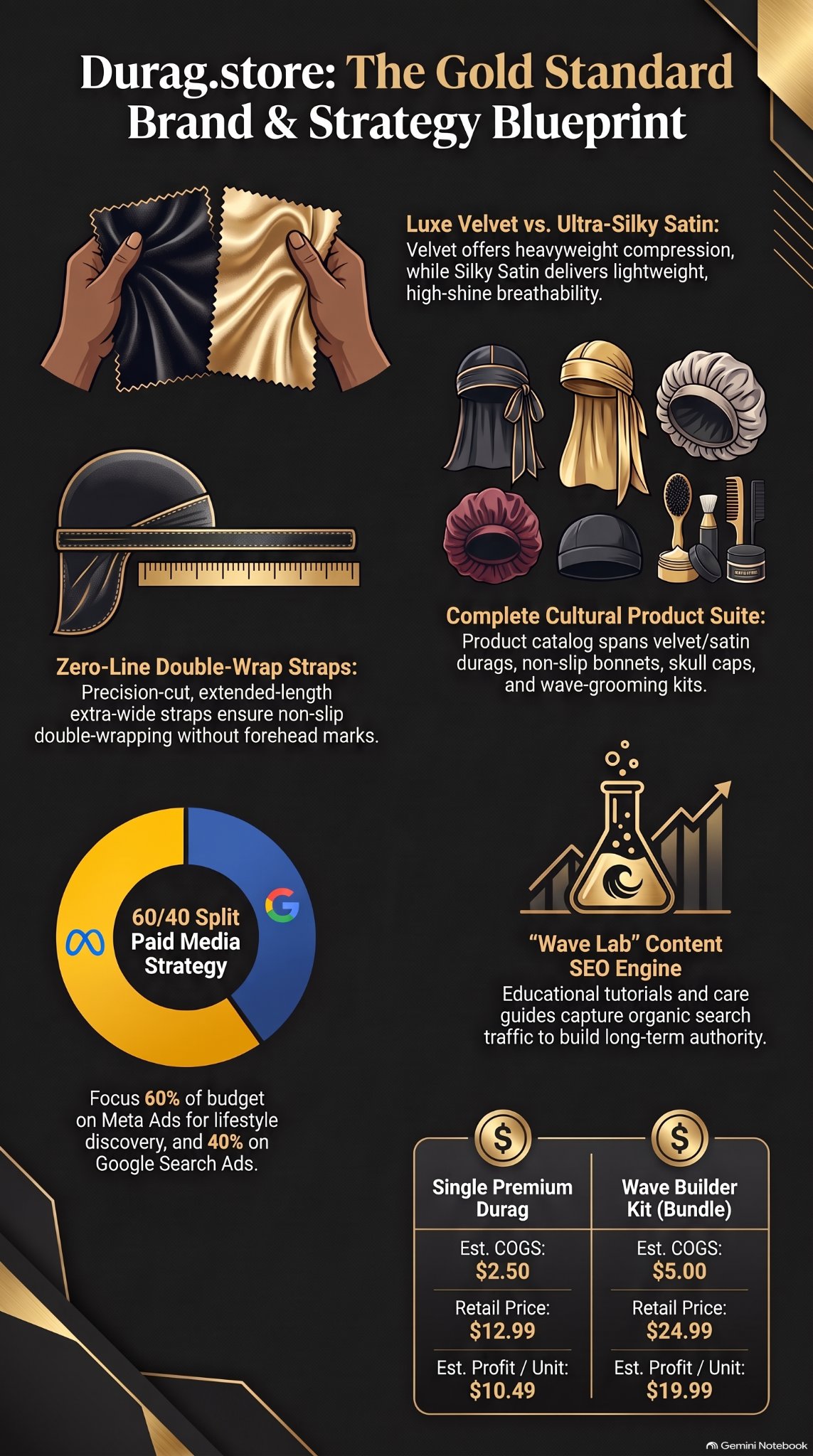
Everything in this guide runs on the right gear: a durag that holds compression without slipping, a cap that stays put, and fabric that treats your hair right. The durag.store launch lineup is built to that standard — dual-layer construction, long tails, and stitching made to survive the routine. Join the launch list and use code GOLDSTANDARD for 15% off your first order.
Keep learning
- How to Put On a Wave Cap the Right Way (and Why Most People Get It Wrong) — Basic · Wave Caps & Skull Caps
- Wave Caps: The Complete Guide to Fit, Wear and Rotation — Basic · Wave Caps & Skull Caps
- Skull Caps: The Low-Profile Layer for Work, Sport and Style — Intermediate · Wave Caps & Skull Caps
Sources: Video — “Which will give u best compression..WAVE CAP or DURAG? [4k]” by Poppy Blasted (@PoppyBlasted360waves), youtube.com. Guide written by the durag.store Wave Lab.