
Wearing Caps Under Hats and Helmets: Protect Your Pattern at Work and Play
Hard hats, helmets, fitted caps, beanies — the day puts things on your head that do not care about your wave pattern. Every hour under an unplanned layer is an hour of random pressure, friction, and sweat working against your training. The defence is a deliberate cap layer underneath, placed correctly, as FENNWAY (@fennway34) demonstrates in the placement video below. This guide covers the layering order, the pressure-point problems and fixes, and how to recover the pattern at the end of the day.
The layering order
The rule: your compression layer touches your hair; everything else touches the compression layer. Brush your pattern in, then place a wave cap or skull cap smoothly — band flat, dome centred, no folds. Then the hat or helmet goes over it. The cap takes the friction and the shifting that the outer layer would otherwise apply directly to your hair.
Never put a helmet or fitted directly on trained hair if you can avoid it. The outer layer's seams, straps and sweatband become the stylists for the day, and none of them know your angles. The cap is cheap, washable, and replaceable; your pattern is none of those.
Pressure points and sweat
Two sore spots plague under-hat wear: where the cap's band crosses a helmet strap or a fitted's sweatband, and the front edge where everything stacks. Fix by offsetting — seat the cap's band a few millimetres above or below the outer layer's band so the lines do not stack into one trench of pressure.
Sweat is the second enemy: it soaks the cap, loosens grip, and salts the hair. Mesh caps breathe best under helmets; on heavy days, a midday swap to a dry cap — thirty seconds in a locker room — restores the system completely. Carry the spare. Future you, at hour six, says thanks.
End-of-day recovery
When the outer layer comes off, do not judge the pattern immediately — it has been pressed in odd directions for hours and looks worse than it is. The recovery is short: moisturise lightly, brush a proper session in your true directions, and let compression (durag or cap) reset it for the evening. Ten minutes returns what the workday borrowed.
If your job means helmets daily, build the habit loop tight: cap on with the uniform, recovery session with the uniform off. Wavers in construction, warehouses, kitchens, and on bikes hold elite patterns — the secret is never talent. It is a cap layer and a recovery session, repeated without negotiation.
Watch: correct wave cap placement from FENNWAY — placement matters double under a helmet
Video: “How to put a wave cap on THE RIGHT WAY” by FENNWAY (@fennway34) · Watch on YouTube
Shop the gear
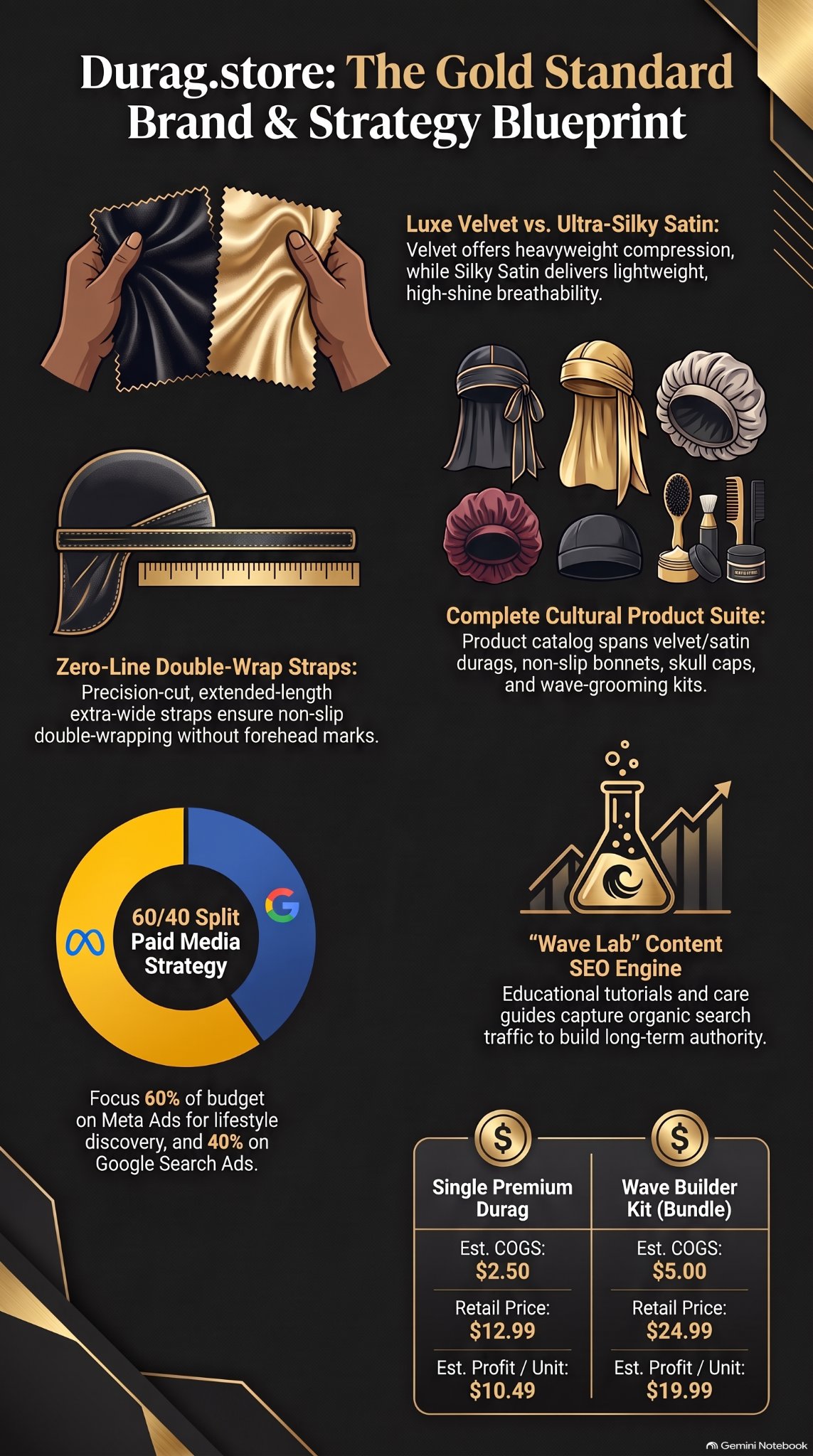
Everything in this guide runs on the right gear: a durag that holds compression without slipping, a cap that stays put, and fabric that treats your hair right. The durag.store launch lineup is built to that standard — dual-layer construction, long tails, and stitching made to survive the routine. Join the launch list and use code GOLDSTANDARD for 15% off your first order.
Keep learning
- How to Put On a Wave Cap the Right Way (and Why Most People Get It Wrong) — Basic · Wave Caps & Skull Caps
- Durag vs Wave Cap: Which One Actually Compresses Better? — Basic · Wave Caps & Skull Caps
- Wave Caps: The Complete Guide to Fit, Wear and Rotation — Basic · Wave Caps & Skull Caps
Sources: Video — “How to put a wave cap on THE RIGHT WAY” by FENNWAY (@fennway34), youtube.com. Guide written by the durag.store Wave Lab.